
“Trust the process.” A cliche I have heard used (and used myself) constantly in today’s world of sports. It seems like every coach in America is talking about “process,” from Nick Saban to local little league coaches. Every one of these coaches is correct, but there’s a problem. I agree that it is vitally important to worry about the process more than the result or the outcome, but how do we do that exactly? What does it look like to worry about the process? What do coaches mean when they say that? If we don’t teach what it actually looks like and give people the tools to accomplish it, then it becomes just another cliche that coaches use to sound like they are actually coaching. Most coaches understand how to utilize it from a physical standpoint, teaching skills in stages, one building on the last, advancing until the skill is mastered. That is certainly process oriented and we as coaches work constantly on teaching skills in this manner, but what about what goes on in our heads? Physical process is important, but we must also teach the mental skills needed to be successful. The mind is the motor that makes the body work and training the mind will not only help athletes on the field of play, but in their lives away from sports. It is a tool that can help all people succeed in everyday life.
There are four key components that must be controlled to remain processed oriented. We are often scared of outcomes. Therefore, we must learn to control that F.E.A.R. The acronym stands for Focus, Energy/Effort, Attitude, and Response. These are all parts of our life that we have the ability to control in every situation, and if trained properly, we will dominate our fear of outcomes, stay focused on the process, and ultimately achieve our goals. The first step is being able to stay focused on the task at hand.
Focus
Quick. Clear your mind. Nothing in it all. When I say “Go,” close your eyes, make your mind completely blank and count to ten, only focusing on the numbers. Ready, Go!
Were you able to get to ten without any other thoughts creeping into your head? How many things did you think about in those ten seconds. Did you think, “Man this is stupid” or maybe “What am I having for dinner tonight?” The human mind is never completely without thought, which makes it extremely difficult for us to focus on any one thing for very long. We have so much going on in our lives that our minds are never settled. Much like a monkey swinging from tree to tree, our minds move from thought to thought at a rapid pace, but the ability to slow our minds down and focus on a given thought or task is actually a skill we can acquire. It just takes knowing the necessary skills and then practicing them as often as we can. We should start with the most important aspect of life, breathing.
Awareness of Breath
The average human takes between 17,000 and 30,000 breaths per day, but how many do we actually pay attention to and notice? The most effective way to slow ourselves down, reach a state of calmness, and center our focus on a given thought or task is by intentional breathing. George Mumford, in his book The Mindful Athlete, talks about what he calls “awareness of breath (AOB)” He says, “As you bring your awareness fully to each breath, you bring your mind back to the present moment; whatever distractions may be there dissipate in the vastness of the present moment, and your perception of things around you starts to slow down.” We must try to find our “center.” Everybody has a center; that place where they are the most calm, focused, and controlled. I am not sure I have ever actually reached mine, but the closer I get, the more calm and better focused I seem to be. With my players, we call this being “present.” We try to live in the present moment, completely focused on the task at hand. When a teacher calls roll in school, the typical response is “here,” but I challenge my players and students to answer “present” instead. I want them to be present, in the moment, and focused, not just “here.” Anyone one can be “here” and simply take up space. Be present instead. Pay attention in a particular way, on purpose, as if your life depended on it. What is on your mind directly impacts your performance on any given task. Most, if not all, mental coaches and mental training programs talk a lot about breathing as the most important aspect of success because it is the foundation that allows everything else to be possible.
The Engine for Your Car
Navy Seals, some of the most well trained, disciplined people on the planet, use a method called 4×4 breathing to help keep them centered and focused on their mission. In this method, inhale through your nose, deeply and slowly, for four seconds, then let the air out of your mouth slowly for four seconds. Repeat that process four times. As the breaths are being taken, focus on each breath and relaxing your mind. When you are finished you will feel more relaxed and you will be closer to your center, thus closer to being “present.” The closer you are to “present” the better you will be able to perform.
Jaeger Sports advocates mental training for all athletes and has some highly effective mental training guides and practice plans to incorporate into daily practice and into daily life routines. They agree that breathing is vitally important. “At the center of these exercises is the breath and the role it plays in enhancing physical and mental health. The breath, like the engine to your car, is the key to keeping the body and mind running smoothly and efficiently.” As you are performing breathing exercises you can begin to work on positive visualization and imagery. Producing positive outcomes physically is a direct by-product of what thoughts reside in your head. You can learn (through repetitive practice and exercises) how to control your breathing and your thoughts. Take a few minutes each day, find a quiet place, and really pay attention to each breath you take. Focus on each breath and then try to fill your mind with positive images and positive thoughts. The more you practice, through exercises and training, the easier it will be for you to return to your center and instantly focus your mind.
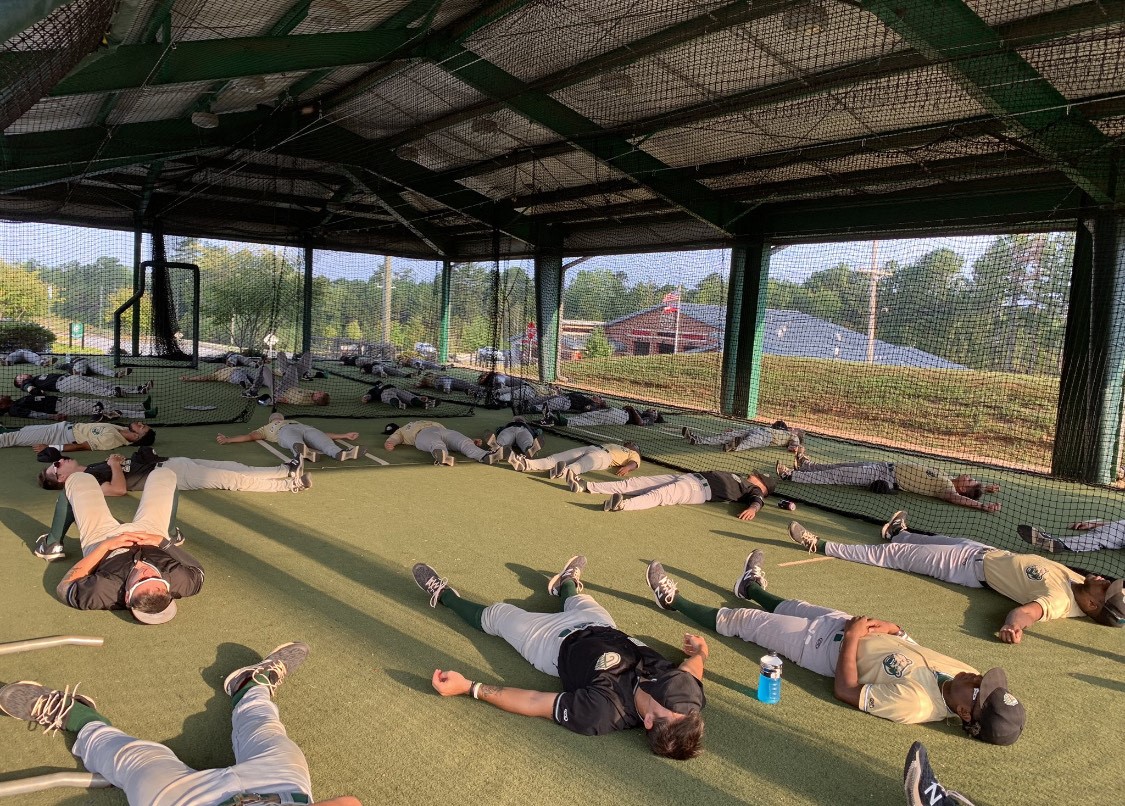 Coach Jeremy Sheetinger at Georgia Gwinnett College has his team do mental exercises almost daily.
https://www.jaegersports.com/training-programs-mental/
Focal Point
Sometimes we lose our way. We all do. Something happens that disturbs us, upsets us, or makes us mad, causing us to fill our minds with negative thoughts. These negative thoughts cause us to lose focus, directly affecting the outcome we desire. You are running late for an appointment and driving hurriedly down the road until another vehicle cuts you off and drives 30 miles per hour in front of you. Road rage kicks in almost instantly. You get angry, yelling and screaming at the car in front of you even though you know they cannot hear you. You speed up and tailgate them to let them know you are upset. Maybe you even tell them hello with four of your fingers missing. Oops, you miss your turn and are now stuck going ten minutes out of your way and will certainly be late to your appointment, all because you lost focus and allowed negative thoughts to control your brain and your actions.
Practicing and performing breathing techniques and controlling your center will provide the tools to navigate situations like this and others that may present themselves in life or in sports. The more you practice the easier it is to come back to the center and focus. One of those tools is a focal point. A focal point is a specific object or point that instantly reminds your brain to slow down, focus on your breaths, and return to your center by flushing away negative thoughts. In baseball, my athletes each have their own somewhere at the field, or it may be part of their equipment or uniform. When they feel anger, failure, or negative thoughts creep into their minds, they take a second, find their focal point and breath. They have the tools to get them back to center, focus on their task, and visualize their results. It may be the toe of the left shoe, a rubber band on the wrist, or the top of the right field foul pole. Pick something that will always be there and then use it to slow down when needed. Focus on the object, inhale deeply through your nose and exhale deeply through your mouth, while remembering what you are trying to accomplish. Flush away negative thoughts and fill your mind with positive visualization. If you have performed mental exercises and practiced, the focal point will instantly take your mind and body back to the training and give you a better chance at a positive outcome. Train your mind and your body will follow. So the next time your pitcher walks the bases loaded in the first inning, you are at the plate in a crucial situation, or a crazy driver cuts you off in traffic, find your focal point, visualize your outcome, and do what you do 30,000 times a day. Just breath.


 separate-yourself.com
Leave a comment